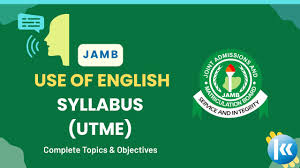
What is the Syllabus for JAMB Use of English?
If you are preparing for the JAMB UTME, one question will always come up: what is the syllabus for JAMB Use of English? This subject is compulsory for every candidate, no matter the course you want to study.
It carries 60 questions out of the total 180 in the exam, so a strong performance here can really boost your overall score. Many students find Use of English tricky, but once you understand the syllabus clearly, it becomes one of the easiest ways to gain marks.
The JAMB Use of English syllabus helps you know exactly what topics to expect. It focuses on testing your ability to read, understand, and use the English language properly at the university level.
The goal is simple: make sure you can communicate effectively and handle academic work in English. In this detailed guide, we will break down the entire syllabus section by section, explain what each part means, give practical examples, and share useful study tips. By the end, you will have a clear roadmap to prepare confidently and score high.
Why the JAMB Use of English Syllabus Matters
Before diving into the topics, let us talk about why this syllabus is so important. JAMB designs the Use of English paper to check real-life language skills, not just book knowledge. You need to show you can read passages from different fields, pick out main ideas, choose the right words, build correct sentences, and even handle spoken English sounds.
Many candidates lose marks because they study randomly without following the official areas of concentration. When you stick to the syllabus, you avoid wasting time on irrelevant topics and focus on what JAMB actually tests. The syllabus has stayed consistent in its structure for recent years, with three main sections that cover reading, grammar and vocabulary, and oral skills. Understanding this structure early gives you an edge.
The exam tests your readiness for tertiary education. Lecturers expect students who can read textbooks, write reports, understand lectures, and speak clearly. That is why JAMB puts so much weight on Use of English. Scoring 40 or more out of 60 in this section is very achievable if you prepare the right way.
General Objectives of the JAMB Use of English Syllabus
According to the official syllabus, the main aims are:
- To test your ability to communicate effectively in both written and spoken English.
- To help you use English confidently for learning at the university level.
- To assess skills in comprehension, summary writing, lexis (word knowledge), structure (grammar), and oral forms (pronunciation and speech patterns).
These objectives guide every question you will see. JAMB wants candidates who can think critically while reading, choose precise words, form correct sentences, and recognize proper pronunciation. Keep these goals in mind as you study – they will help you understand the “why” behind each topic.
Structure of the JAMB Use of English Exam
The Use of English paper always has 60 multiple-choice questions divided into three sections:
- Section A: Comprehension and Summary – Usually around 25 questions.
- Section B: Lexis and Structure – Covers vocabulary, grammar, and sentence patterns.
- Section C: Oral Forms – Focuses on pronunciation, stress, and intonation.
One passage is often a cloze test (fill-in-the-blanks), and there is usually a recommended novel that contributes questions. Knowing this breakdown helps you manage your time during the CBT exam. Aim to spend more time on comprehension since it carries significant weight.
Now, let us go through each section in detail.
Section A: Comprehension and Summary
This is the first and often the heaviest section. It tests how well you understand written English. You will face two main passages, each about 200 words long, drawn from different disciplines like science, social issues, history, or everyday life. One of them is usually a cloze test.
Key Topics in Comprehension and Summary
- Description Passages here describe people, places, objects, or processes in detail. You need to identify specific details, the order of events, or characteristics mentioned. Example: A passage might describe a traditional Nigerian festival, and questions will ask about the main features or the sequence of activities.
- Narration These passages tell a story or recount events. Focus on the plot, characters, sequence of actions, and the outcome. Questions often test chronological order or cause and effect. Tip: Pay attention to time words like “first,” “then,” “after,” “finally.”
- Exposition Expository passages explain ideas, processes, or concepts. They might explain how something works, why an event happened, or give information on a topic. Look for facts, explanations, and logical flow.
- Argumentation/Persuasion Here, the writer tries to convince you of a point of view. You must identify the author’s opinion, supporting arguments, counter-arguments, and conclusion. Questions may ask for the writer’s tone or main claim.
In addition to these styles, you will handle:
- Cloze Test: A passage with blanks where you choose the best word or phrase to fill each gap. This tests vocabulary in context, grammar, and overall understanding.
- Summary Writing Skills: You may get a passage and questions that test your ability to identify main ideas, supporting details, and condense information without losing meaning.
- Inference and Logical Conclusions: Many questions require you to read between the lines – what is implied but not directly stated?
- Coherence and Cohesion: How ideas connect in the passage using linking words.
How to Prepare for Comprehension and Summary
- Practice reading different types of passages daily. Newspapers, magazines, and simple academic articles help.
- Time yourself: Try to read a 200-word passage and answer questions in 8-10 minutes.
- For cloze tests, read the entire passage first to understand the context before filling blanks.
- Build the habit of identifying topic sentences and main ideas quickly.
- For summary, practice extracting key points and rephrasing them in your own words (even though the exam is multiple choice, this skill improves accuracy).
Many candidates struggle here because they rush or fail to understand the passage fully. Slow down, underline key points if allowed (in CBT, mentally note them), and eliminate wrong options logically.
The recommended novel also falls under this section in many years. For recent sittings, candidates study a specific book like The Lekki Headmaster by Kabir Alabi Garba or similar approved texts. Questions from the novel test plot, characters, themes, lessons, and specific events. Read the novel at least twice, make notes on main characters, conflicts, and moral lessons. JAMB often asks straightforward questions from the book, so thorough reading pays off.
Section B: Lexis and Structure
This section examines your knowledge of words (lexis) and how they fit together in sentences (structure). It is a big scorer if you have a good vocabulary and solid grammar foundation.
Main Topics Covered
- Synonyms Words that have similar meanings. You will see a word in a sentence and choose the closest option. Example: “The politician’s speech was eloquent.” Options might include fluent, powerful, boring, etc. Context matters – choose the one that fits best.
- Antonyms Opposite meanings. Again, context is key. “The weather was inclement” – the antonym could be mild or pleasant.
- Homonyms Words that sound the same or are spelled the same but have different meanings (e.g., bank as financial institution or river side). Questions test your ability to distinguish them.
- Sentence Interpretation You read a sentence and choose the option that best explains its meaning. This tests understanding of idioms, figurative language, and nuances.
- Idiomatic Expressions Common phrases whose meaning is not literal, like “kick the bucket” or “break the ice.” Learn popular ones used in Nigerian contexts and standard English.
- Word Classes and Their Functions Nouns, verbs, adjectives, adverbs, prepositions, conjunctions, etc. Know how they work in sentences. Questions may ask for the part of speech or how a word functions.
- Clause and Sentence Patterns Simple, compound, complex sentences. Identify main clauses, subordinate clauses, and correct sentence structures.
- Mood, Tense, Aspect, Number, Agreement/Concord, Degree (Positive, Comparative, Superlative), and Question Tags This is heavy on grammar:
- Tense: Past, present, future, perfect forms, etc. Choose the correct verb form.
- Concord (Subject-Verb Agreement): “The boys is playing” is wrong; it should be “are.”
- Degrees of Comparison: Big, bigger, biggest; good, better, best.
- Question Tags: “You are coming, aren’t you?”
- Mood: Indicative, imperative, subjunctive.
- Punctuation and Spelling Correct use of commas, full stops, question marks, apostrophes, etc. Some questions test common spelling errors.
Tips for Lexis and Structure
- Build vocabulary daily. Learn 10-15 new words with their synonyms, antonyms, and example sentences.
- Study grammar rules one by one. Use simple explanations and plenty of exercises.
- Practice with past JAMB questions – many patterns repeat.
- Pay attention to Nigerian English vs standard British/American usage, but JAMB mostly follows standard international English.
- For idioms and homonyms, create your own sentences to remember them better.
This section rewards consistent practice. Students who read widely and revise grammar rules score higher here.
Section C: Oral Forms
Many Nigerian students find this section challenging because it deals with spoken English, which is not emphasized much in some schools. However, it is straightforward once you understand the patterns.
Key Topics in Oral Forms
- Vowels and Consonants You will identify correct pronunciation of sounds. Questions often use phonetic symbols or ask which word has a different sound from others. Example: Which word has the /i:/ sound? Seat, sit, set, etc.
- Diphthongs Combination sounds like /ai/ in “price,” /au/ in “house,” /ei/ in “face.”
- Consonant Clusters Groups of consonants together, like “strength” or “splash.”
- Stress and Intonation
- Word Stress: Which syllable is stressed in a word? (e.g., CONduct vs conDUCT).
- Sentence Stress: Emphasis on certain words in a sentence to change meaning.
- Intonation: Rising or falling tone at the end of sentences (questions usually rise).
- Rhymes Words that end with the same sound, like “cat” and “hat.” You may identify rhyming pairs or the odd one out.
- Syllable Structure Breaking words into syllables and understanding patterns.
- Phonetic Symbols and Transcription Basic knowledge of how sounds are represented. You do not need to be an expert, but recognize common symbols.
How to Master Oral English
- Listen to native or good speakers on BBC, CNN, or reputable podcasts. Pay attention to pronunciation.
- Use a dictionary with phonetic transcription (Oxford or Cambridge).
- Practice minimal pairs: words that differ by only one sound (ship/sheep, bit/beat).
- Record yourself reading aloud and compare with correct pronunciation.
- Learn common stress rules: nouns and adjectives often stress the first syllable, verbs the second, etc.
- For rhymes and stress, do plenty of “odd one out” exercises.
Even if your spoken English has a local accent, JAMB tests recognition of standard sounds. Consistent listening and practice make a big difference.
The Recommended Novel for JAMB Use of English
Every year, JAMB prescribes one novel that all candidates must read. Questions from this book usually appear in the comprehension or summary section. Recent approved texts have included titles like The Lekki Headmaster by Kabir Alabi Garba.
When reading the novel:
- Note the author, setting, plot summary, main characters and their roles.
- Identify themes, conflicts, and resolutions.
- Understand moral lessons or messages the author passes.
- Pay attention to key events and quotations that might be tested.
Do not just read for story – read analytically. Many candidates score easy marks from the novel because the questions are often direct.
Recommended Textbooks for JAMB Use of English
JAMB provides a list of approved books to help your preparation. Some useful ones include:
- Doses of Grammar by M.A. Adedimeji
- Practice in Spoken English by M.O. Attah
- Books by authors like Bamgbose, Banjo, Egbe, Elugbe, and others focusing on grammar, lexis, and oral English.
- Invisible Teacher of JAMB Use of English by Dele Ashade (popular among candidates for exam-oriented tips).
Use at least two or three of these alongside past questions. Past questions are gold – they show the exact style and difficulty level JAMB uses.
Effective Study Strategies for JAMB Use of English
To make the most of the syllabus, follow these practical steps:
- Create a Study Timetable: Allocate time to each section. Spend more days on your weak areas. For example, if oral English is difficult, practice it daily for 30 minutes.
- Read Widely: Read newspapers (like The Guardian or Vanguard), novels, and simple science articles. This improves comprehension and vocabulary naturally.
- Practice Daily with Past Questions: Solve at least 20-30 Use of English questions every day. Review mistakes and understand why the correct option is right.
- Join Study Groups: Discuss passages, debate meanings, and practice oral drills with friends. Teaching others helps you learn better.
- Focus on Speed and Accuracy: The CBT exam is timed. Train yourself to answer questions quickly without guessing wildly.
- Use Audio Resources: For oral forms, listen to pronunciation apps or YouTube channels dedicated to English sounds.
- Revise the Novel Thoroughly: Summarize chapters and create possible questions.
- Track Your Progress: Take full mock tests weekly and note improvements in each section.
Start preparation early. Even if you think your English is good, JAMB has specific expectations. Consistent effort over months beats last-minute cramming.
Common Mistakes Candidates Make and How to Avoid Them
- Ignoring the Syllabus: Some study only what they like. Stick to the official topics.
- Poor Time Management: Spending too long on one passage. Practice under timed conditions.
- Guessing Without Elimination: Always read all options and eliminate wrong ones.
- Neglecting Oral English: Many assume it is minor, but it can cost 10-15 marks.
- Not Reading the Novel: Easy marks lost here.
- Overlooking Context: Choosing synonyms or antonyms without considering the sentence.
- Weak Grammar Foundation: Revise rules like concord and tenses repeatedly.
Avoid these by being deliberate in your preparation.
Benefits of Mastering the JAMB Use of English Syllabus
When you cover the syllabus well, you gain more than just exam marks. You improve your overall communication skills, which will help in university and beyond. Good English helps in writing assignments, giving presentations, and even job interviews later.
High scorers in Use of English often report better confidence in other subjects because they understand questions faster. It also contributes significantly to crossing the 200 or 250+ UTME score many competitive courses require.
Final Tips to Score High in JAMB Use of English
- Start with the novel – finish it early.
- Master comprehension techniques: skim for main ideas, scan for details.
- Build a personal word bank with synonyms, antonyms, and idioms.
- Practice pronunciation daily, even for 15 minutes.
- Solve at least 10 years of past JAMB Use of English questions.
- Stay calm during the exam. Read instructions carefully.
- If a question is tough, move on and return later.
Remember, consistency beats intensity. Study a little every day rather than many hours in one sitting.
The JAMB Use of English syllabus is your blueprint for success in this compulsory paper. It covers comprehension and summary, lexis and structure, and oral forms in a balanced way. By understanding each section, practicing regularly, reading the recommended novel, and using good textbooks, you can aim for 50+ marks out of 60.
Thousands of candidates have scored excellently in this subject by simply following the syllabus. You can do the same. Start today, stay focused, and believe in your ability to excel. Good luck with your JAMB preparation – may your efforts bring the admission you desire.